
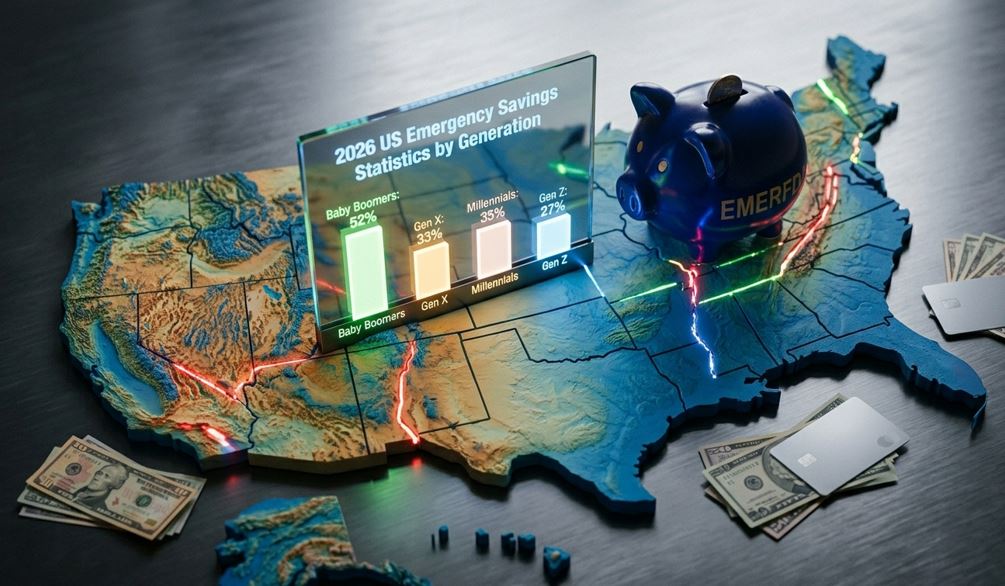
Only 47% of Americans have enough savings to cover a $1,000 emergency expense as of early 2026. According to recent financial reports, the remaining 53% of the population would be forced to rely on credit cards, personal loans, or financial assistance from family to handle a sudden four-figure bill. Furthermore, approximately 24% of U.S. adults report having no emergency savings at all, a figure that has remained stubbornly high due to persistent inflation and rising living costs.
At Emerfd, we monitor these national benchmarks to help individuals gauge their financial resilience against real-world economic data.
Emergency Savings Statistics by Generation (2026)
The ability to cover a surprise $1,000 expense varies significantly across different age groups. Data suggests that older generations typically maintain higher liquidity, while younger adults face greater hurdles:
-
Baby Boomers: The most resilient group, with 52% reporting more emergency savings than credit card debt.
-
Gen X and Millennials: These groups are the most likely to be “debt-heavy,” with roughly 33–35% carrying more credit card debt than cash reserves.
-
Gen Z: Interestingly, 27% of Gen Z report having no debt but also zero emergency savings, leaving them highly vulnerable to a single financial shock.
The Diagnostic Process: Why Savings Are Stagnating
To understand why more than half of Americans struggle to reach the $1,000 milestone, our analysts at Emerfd highlight three primary economic “symptoms”:
-
The Inflation Gap: 54% of Americans cite rising costs as the primary reason they cannot increase their liquid emergency fund.
-
Debt Prioritization: 31% of households are currently attempting to pay down high-interest credit cards while simultaneously saving, which slows the growth of their cash buffer.
-
Income Volatility: Changes in employment or stagnant wages have caused 58% of adults to report that their savings have either decreased or stayed the same compared to last year.
Why Choose Emerfd to Benchmark Your Savings?
While standard news reports give you the “what,” Emerfd provides the “how.” We offer specialized tools that allow you to compare your current savings progress against localized cost-of-living data. By understanding where you stand in relation to the national average, you can better implement a strategic emergency fund plan that accounts for 2026’s unique economic pressures.
Ready to join the 47% who are financially prepared? Visit Emerfd today to access our free financial benchmarks and step-by-step guides for building a robust safety net.