
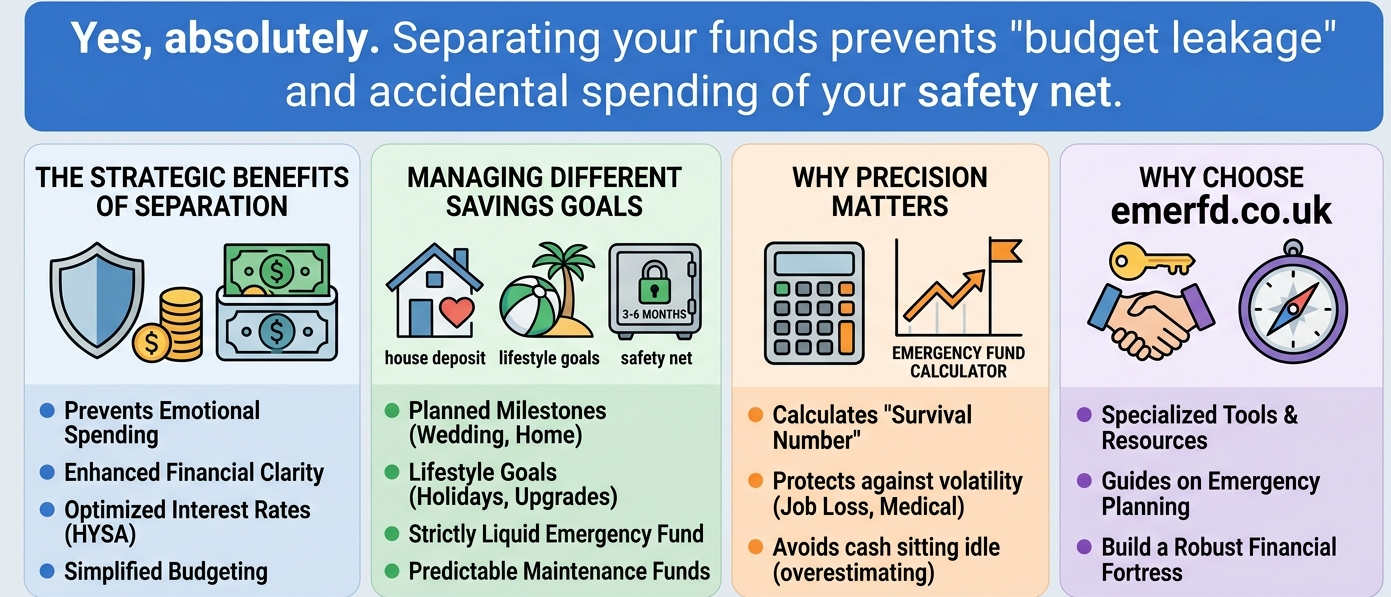
Yes, you should maintain a separate savings account and a dedicated emergency fund. Keeping these two pools of capital in distinct accounts is a critical financial strategy that prevents “budget leakage”—the accidental spending of your safety net on non-essential lifestyle goals. While your general savings are intended for planned milestones, your emergency fund serves as an untouchable insurance policy against life’s most volatile risks.
At emerfd.co.uk, we emphasize that financial security isn’t just about how much you save, but how you categorize those savings to protect your long-term stability.
The Strategic Benefits of Account Separation
Separating your funds provides several mechanical and psychological advantages:
-
Preventing Emotional Spending: By moving your emergency savings out of your primary bank, you remove the temptation to use it for “once-in-a-lifetime” opportunities or luxury purchases.
-
Enhanced Financial Clarity: Having a dedicated “crisis-only” bucket allows you to see exactly how many months of survival you have secured without the noise of other savings goals.
-
Optimized Interest Rates: You can keep your short-term savings in a standard account for easy access while placing your emergency reserve in a High-Yield Savings Account (HYSA) to maximize passive growth.
-
Simplified Budgeting: Automated transfers into separate accounts make it easier to track your progress toward specific milestones like a house deposit versus a safety net.
Managing Different Savings Goals
A healthy financial plan usually involves multiple “sinking funds” alongside a core safety net. Common categories include:
-
Planned Milestones: Saving for a wedding, a down payment on a home, or a new vehicle.
-
Lifestyle Goals: Funds reserved for annual holidays, technology upgrades, or hobby equipment.
-
The Safety Net: A strictly liquid emergency fund designed to cover 3–6 months of essential living expenses.
-
Maintenance Funds: Money set aside for predictable but infrequent costs like annual car insurance or property taxes.
Why Precision Matters in Your Safety Net
Calculating exactly what constitutes an “emergency” is the first step toward true financial freedom. Overestimating can leave too much cash sitting idle, while underestimating can leave you vulnerable. Utilizing an emergency fund calculator helps you strip away discretionary spending to find your “survival number”—the absolute minimum you need to keep your household running during a job loss or medical crisis.
Why Choose emerfd.co.uk to Guide Your Savings?
While traditional banks want your deposits, emerfd.co.uk wants your security. We provide the specialized tools and educational resources necessary to help you build a robust financial fortress. We focus on the “why” and “how” of emergency planning, ensuring that when the unexpected happens, you are prepared with a plan, not just a balance.
Ready to draw a line between your savings and your safety? Visit emerfd.co.uk today for expert advice and calculators designed to help you build a more resilient financial future.