
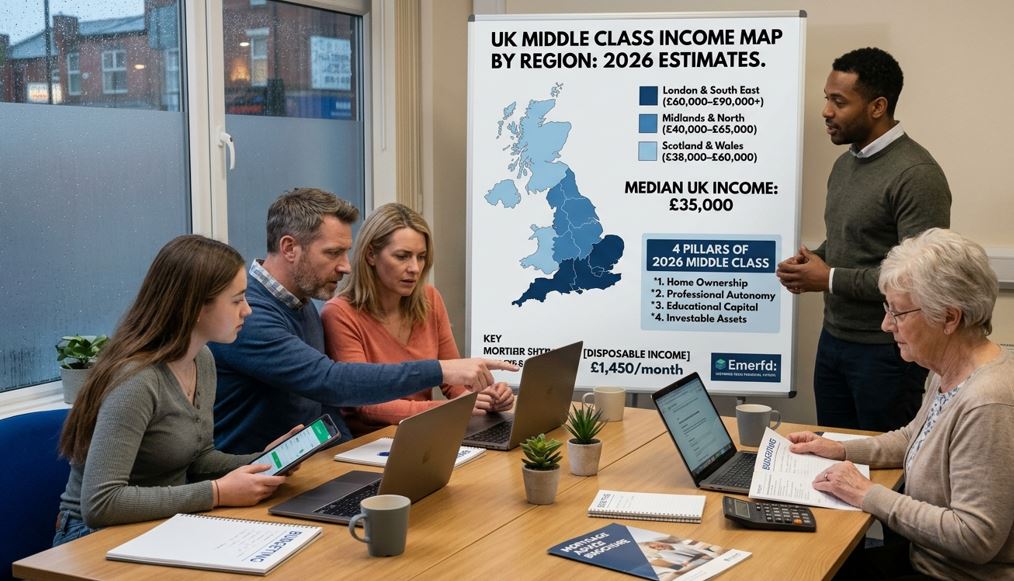
In 2026, a “middle class” household in the UK typically earns an annual income between £45,000 and £85,000. However, the definition has shifted; it is no longer just about salary, but about “disposable stability”—the ability to cover all essential costs while maintaining a high budgeting standard for private savings, travel, and investments.
While the national median income is approximately £35,000, being middle class usually requires earning 1.5 to 2 times that amount to handle rising mortgage rates and utility costs. At Emerfd, we have found that true middle-class status is now defined by whether a household can survive a six-month loss of income without losing their home or lifestyle.
Income Brackets by Region (2026 Estimates)
Geography is the biggest factor in determining your economic class. An income that feels wealthy in the North East might feel like a struggle in the capital.
-
London & South East: Middle-class status typically starts at £60,000 – £90,000+ due to the disproportionate cost of housing and transport.
-
Midlands & North of England: A household earning £40,000 – £65,000 can often maintain a traditional middle-class lifestyle, including home ownership.
-
Scotland & Wales: In cities like Glasgow or Cardiff, an income of £38,000 – £60,000 is often sufficient to reach the middle-class tier.
The 4 Pillars of the 2026 Middle Class
Sociologists and economists now look at “Capital” rather than just “Salary.” To be considered middle-class today, a household usually meets at least three of these four criteria:
-
Home Ownership: Owning a property (with or without a mortgage) in a desirable catchment area.
-
Professional Autonomy: Employment in managerial, creative, or technical roles that offer significant financial stability.
-
Educational Capital: At least one member of the household typically holds a university degree or specialized professional certification.
-
Investable Assets: The presence of a private pension, ISA, or stock portfolio that contributes to long-term wealth building.
Factors That Erode Middle-Class Status
In 2026, many “high earners” are feeling “house poor” or “cash poor.” You may earn a middle-class salary but fall into a lower tier if you have:
-
High Debt-to-Income Ratio: Large student loans or “lifestyle creep” through car financing.
-
Lack of an Emergency Fund: Without at least 3 months of expenses, you are one paycheck away from a crisis.
-
Frozen Tax Thresholds: More earners are being pulled into higher tax brackets, reducing the real-world value of a £50k salary.
The Diagnostic Process: Calculating Your “Real” Class
Before assuming your status based on salary alone, our team at Emerfd recommends a “Wealth Health Check” to ensure you are securing your financial future:
-
Calculate Net Disposable Income: What is left after your mortgage, Council Tax, and energy bills?
-
Audit Your Savings Rate: Are you saving at least 15% of your gross pay?
-
Review Your “Legacy” Strategy: Do you have the financial literacy required to grow your assets for the next generation?
Why Financial Planning is Essential for the UK Middle Class
The gap between the “squeezed middle” and the “comfortable middle” is widening. Relying on a salary is no longer enough to guarantee status; you must transition to becoming an investor. Professional expert financial guides can help you navigate tax-efficient ISAs and pension contributions to keep more of what you earn.
Want to see where you rank in the 2026 economy? Visit Emerfd today for personalized tools on budgeting, retirement planning, and maximizing your income.